











One day, Dr. Wade Newhouse realized he needed a different approach when it came to teaching his Ghost and Vampires class.
Newhouse concluded that the traditional sense of lecturing needed a rebrand.
“I used to see myself as the person who was going to give students access to information they wouldn’t normally get,” Newhouse said. “I’m increasingly asking myself, ‘what am I here to do?’ It might be to facilitate a conversation, but it cannot be just to give information.”
Last spring, Newhouse, the Department Chair of Humanities and Interdisciplinary Arts and Professor of English, devised a system to incorporate immersive learning into his class, putting the students in charge. His class was reading seven books, and for each one, every student was responsible for leading a 15-minute class discussion. Half of the students’ grades are based on the seven discussions they lead.
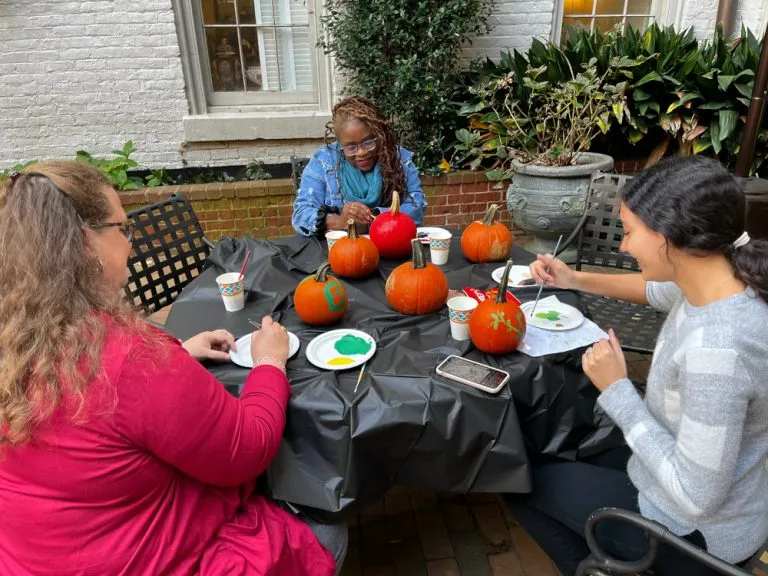
The discussions don’t all have to be a 15-minute lecture. Some students are really good at art, so Newhouse allows them to create a painting about their favorite scene in the book, display it to the class, and explain their inspiration. Some students can initiate a debate during their 15-minute period. Some students bring up a chapter or a scene and give a “hot take” on it. Whatever way they choose to present or discuss it, it’s entirely up to the student.
“It was really, really good,” Newhouse said. “I decided that’s going to be my model from now on.”
Newhouse did it for three different classes, three different groups of students, and discovered “three different degrees of success.”
Newhouse facilitates the discussions, and if he needs to jump in and ask a question to keep the conversation going, he will. He knows the material well, having taught it for many years, so he knows what points should be covered and what questions should be asked. The rest, though, is up to the students.
Dr. Michelle Corvette, Director of Faculty Development and Immersive Learning, is enthusiastic about the concept.
“It’s a game changer in terms of education,” Corvette said. “He watches them learn the student learning outcomes for his course, without the need for exams, without the traditional assessments, because they are demonstrating their knowledge through doing research together, sharing the research, and conducting the discussion.”
THAT’S AN A
At first, Newhouse took notes, but about two-thirds of the way through the semester, he abandoned that approach.
Newhouse quickly realized each version of the presentations was good for different reasons. One student made movies, each one smart and funny. The student would make the movies, present them, and students would ask questions.
Another student might spend hours researching with footnotes and speak for the entire 15 minutes.
“That’s an A,” Newhouse said. “It’s not the same A (as the student who made the movie), but that’s what that student was good at.”
Newhouse said the presentations and conversations produced were way better than anything he would have been able to create. The presentations have made the material and the classes more interesting to him. Newhouse never knows where things will land. He has a rough idea of which way the discussion should go, and is aware some presentations will land better than others. That’s when he finds himself at a crossroads.
“Because they are presenting, their hot take on the topic may not be mine at all,” Newhouse said. “So I have to make the decision, do I give them my hot take? I mean, it’s been that take for the last 50 years, but is that the right take? Their takes are as useful as mine.”
Newhouse is still the expert on the material, but according to Corvette, his ability to step back and facilitate is highly beneficial to the learning process for the students.
“He watches their motivation increase,” Corvette said. “Their engagement increases, and their retention of the information presented increases because they are speaking about it in their language. They relate to each other.”