













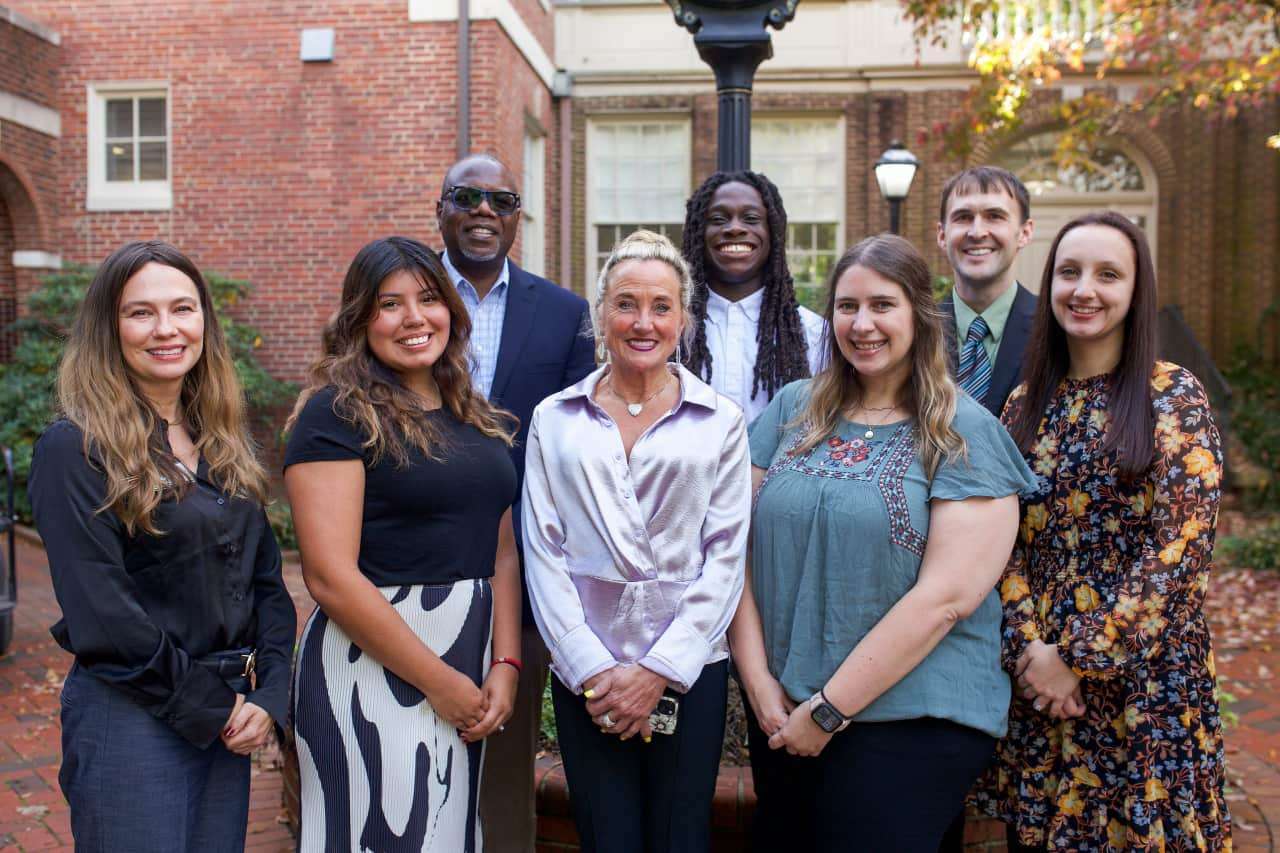




Six students and two faculty members from William Peace University’s user experience design (UX design) program attended UX Y’all, a regional conference focused on the state of the UX field, on September 24 and 25, 2026, at Marbles Kids Museum. Hosted by the Triangle User Experience Professionals Association (Triangle UXPA), the conference gave students a chance to hear from UX experts, network with professionals from leading Triangle firms, and learn about graduate-level field research statewide.
Don Sugar, instructor of user experience design, has served on Triangle UXPA’s executive council for several years. He helped secure funding for Peace students to attend after seeing larger universities sponsor their UX design students.
“I noticed that UNC and NC State were bringing large groups of students, and I wanted Peace students to have the same opportunity,” he said. “While we didn’t have funding to sponsor students ourselves, I took the initiative to speak with the conference co-chairs and ask if I could bring a group with waived fees. The out-of-pocket cost can be high for students, so I wanted to share the opportunity at no cost. They approved six slots for me to bring students.”
Once the funding was secured, Sugar worked alongside Jackson Bostian, assistant professor of user experience design, to select which students would attend.
“We tried to prioritize students majoring in UX because many UX courses overlap with simulation and game design (SGD), and those students have other conferences to attend,” Bostian said. “There are far fewer UX conferences, especially locally. So we wanted to ensure students majoring in user experience design, especially those sure about entering the UX field or seeking internships or jobs soon, had the chance to talk to professionals and network.”
The immersive learning experience was designed to show students the state of the user experience design field and support their career exploration.
“Since many students haven’t had much exposure to user experience design, this was an opportunity to see people doing this work, talk with them, and attend presentations on relevant topics,” Sugar said. “For example, there were many talks about AI, how it’s influencing user experience design and changing the field.”
Career Exploration in Action
Among the group of students who attended the conference were Eva Alperovich ’28, Seth Becker ’28, and Tristan Jones ’28.
Jones is an SGD major who transferred to Peace this fall. As a newer student in Peace’s program, the conference helped him better understand the current state of the UX field, especially among professionals in the Triangle.
“I learned some of the issues UX professionals face,” he said. “Sometimes they don’t get as much respect as they should, so they need to make sure higher-ups know their job is useful. Also, with AI’s rise, leadership sometimes tries to replace them with AI or use it to speed up research. The conference covered a lot about AI.”
Although still uncertain about his exact career path, the conference helped Jones clarify long-term goals he had been pondering.
“It gave me a better sense of careers in the field and showed me I probably want to be more of an engineer than a traditional UX designer,” he said. “I want to be the person building the products, using the research UX designers gather to improve them.”
After transferring from Wake Technical Community College this fall through the Peace Pathways partnership, Alperovich has enjoyed the immersive learning in her UX design classes. The conference helped her visualize career paths beyond graduation and confirmed her passion for UX.
“It felt interesting because I could see people in the field and what their careers look like,” she said. “When I decided to pursue UX as a junior in high school, I had no idea what a lifestyle as a UX designer might look like or what kind of person I could be while maintaining this job. Seeing examples of successful people in the field, the work they have done, and the impact they’ve had on their community through UX was really cool.”
Her biggest takeaways focused on AI in the field and the role she wants to play in the broader UX landscape.
“There were many warnings about AI’s advancements and how we, as UX designers, must stick to our core role and not let AI take over all the critical thinking,” she said. “One memorable moment was a speaker assessing what AI can do well and what it can’t. It showed me humans still have to think critically, process information, and make final decisions. That was empowering because I want to stick with this field and train myself to be a critical thinker so I can make those decisions.”
After the conference, she met with Bostian to discuss the career paths the presentations highlighted.
“Professor Bostian helped me see there are many pathways in UX,” she said. “I’ve become interested in project management and designing for spaces, physical items, and processes or events. I know interfaces are important, but sometimes we forget core human needs, like grocery store layouts. We can incorporate UX design and make a big difference in those simple things.”
Becker initially came to Peace for its SGD program, but eventually became more interested in UX design and the opportunities it afforded him to think more critically about individual needs.
“I saw that UX is varied,” he said. “It has many aspects, and the field is rooted in critical thinking. The conference helped me see where the industry stands today, especially at the corporate level. It showed me I’ll probably want to seek less corporate jobs and more small business-type jobs, at least right out of college, especially because of the AI push.”

Faculty Expertise on Display
Beyond attending the conference with students, Bostian also delivered a presentation showcasing his UX research and expertise. As part of the “Lightning Talks” segment of the program, Bostian explored how cultural artifacts serve as mental models that shape users’ expectations of new technologies, in line with the conference’s overall theme of “Human. By Design.”
“It’s the idea that when you have a big blockbuster hit like Back to the Future 2, it informs the cultural understanding of something like virtual reality (VR) and what it might be capable of decades before the technology actually exists,” Bostian said. “Now, if you look at VR, it looks very similar to what it looked like in that film. And that’s not because the film was so prescient; it’s because the film’s portrayal influenced how people later designed the technology.”
Bostian emphasized how beneficial it is for students to see concepts discussed in class in real-life scenarios, which helps them identify trends and developments in the field.
“We’re going from an environment where we’re the UX experts on campus to one where everyone around us is having the same conversations, and all of a sudden it’s clear that these takeaways are pertinent,” he said.
He also hoped students would leave the conference with a clearer understanding of UX’s broad influence and the range of career paths available to them with a degree in UX design from Peace.
“UX exists across many industries, such as healthcare, technology, and law,” Bostian said. “It’s easy for students to think of UX as just something they do for class. In this environment, they can see how UX applies across disciplines and where they overlap. That’s one of the things that most excites me about UX, and I think that going to the conference was a really great way to show students that you’re not in a vacuum when you do UX in the professional world.”


