










William Peace University biology students are taking learning beyond the classroom and into local waterways through an environmental research project examining polychlorinated biphenyls (PCBs) in local fish populations decades after the pollution first occurred.
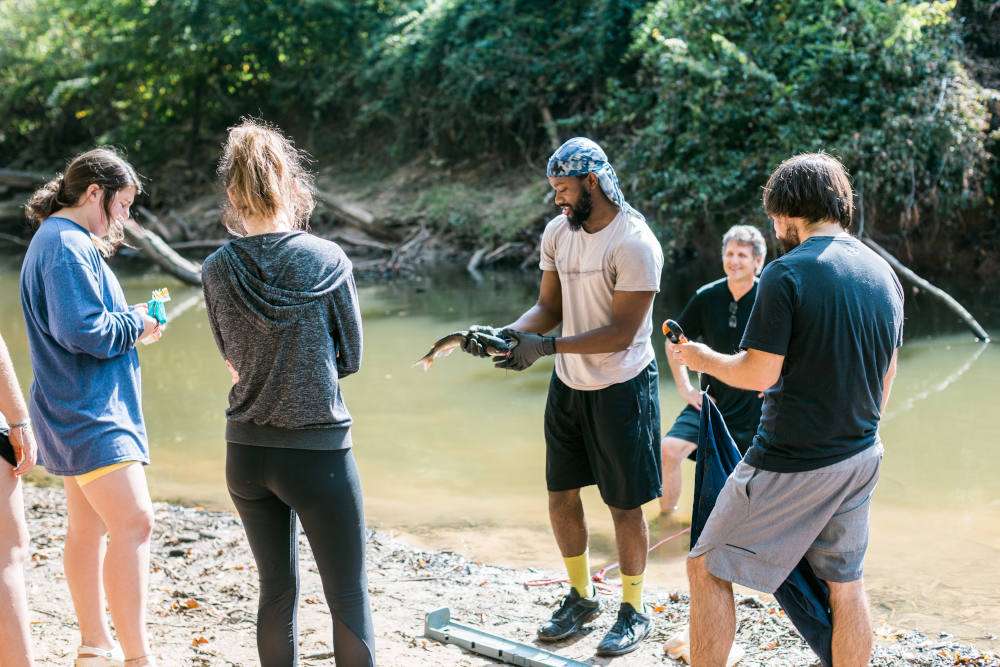
Patrick Myer, associate professor of biology, routinely takes a group of students out of the classroom and into the Neuse River, where they collect fish samples from five sites along a 22-mile stretch of stream, beginning near Crabtree Creek.
The stream serves as a living classroom, offering Peace students consistent, field-based learning opportunities. Through research using professional techniques, students gain practical experience while contributing to meaningful environmental science work that not only informs public health conversations but also prepares them for future careers in biology and environmental research. Peace graduates have gone to work for the North Carolina Wildlife Resources Commission, the North Carolina Division of Water Resources, the Maine Department of Inland Fisheries and Wildlife, and the North Carolina Natural Science Museum.
“We did some preliminary studies decades ago, looking at contamination of what we figured would be a fish that someone would eat out of that stream,” Myer said. “We focused on channel catfish, which became our target species.”
Peace students have partnered with a laboratory at North Carolina State University to conduct the research.
The study asks a critical question: Are PCBs still present in fish that people might eat today?
Signage from the North Carolina Wildlife Resources Commission along the creek offers mixed guidance on fish consumption, according to Myer. Some signs near the headwaters warn against eating fish altogether, while others farther downstream suggest limiting consumption to one fish per month, despite known PCB contamination.
Early findings from the study indicate PCB levels may still pose serious health risks, reinforcing long-standing warnings against eating fish from the stream, particularly after storms.
“In our initial studies, the water quality was especially poor following heavy rain,” Myer said. “Even using basic field testing kits, the fish showed contamination levels that suggested a significant cancer risk.”
Student Involvement
Peace students are actively involved in every phase of the research, from field sampling to fish tagging and data collection.
Students collect muscle tissue samples — the parts humans typically consume — giving the research direct real-world relevance. By measuring PCB contamination in edible tissue, the study directly addresses public health concerns. This approach connects classroom science to real environmental and health implications, showing students how research informs real-world decisions.
“The immersive learning sets Peace apart,” Elise Langer ՚28 said. “Research like this puts everything I’ve learned over the past three years into actual application.”
The students set up traps in the creek, take the temperature of the water, and measure and weigh the fish to see if they meet the criteria for their research. Langer, a biology major who completed NSF research last summer, felt like she got real-world work experience with this research.
“It’s really put me out of my comfort zone, just trying new things in science,” Langer said. “This is really making me step into what I would look like if I were a field researcher. The best part about biology is that it’s multifaceted, and that’s what you get at Peace, you get a little bit of everything.”
In addition to measuring contamination, students are learning how environmental systems respond to extreme conditions. Myer noted that heavy storms often wash fish downstream, making recapture rare and highlighting how quickly ecosystems can be disrupted — and how rapidly they can recover. Between 800 and 1,000 fish have been tagged in the stream, yet from year to year, they are rarely caught again.
“This is an early phase study, so it’s going to take several years before we actually get this final answer,” Myer said. “But that’s what it’s all about because that’s what science is. You discover something, and then you get that information out.”