













Every day, students at William Peace University are challenged to excel through immersive learning opportunities, close connections with faculty, and a campus culture focused on career preparation. Sometimes that path includes continued education beyond Peace’s campus in graduate and doctoral programs, turning broad interests into specialized expertise.
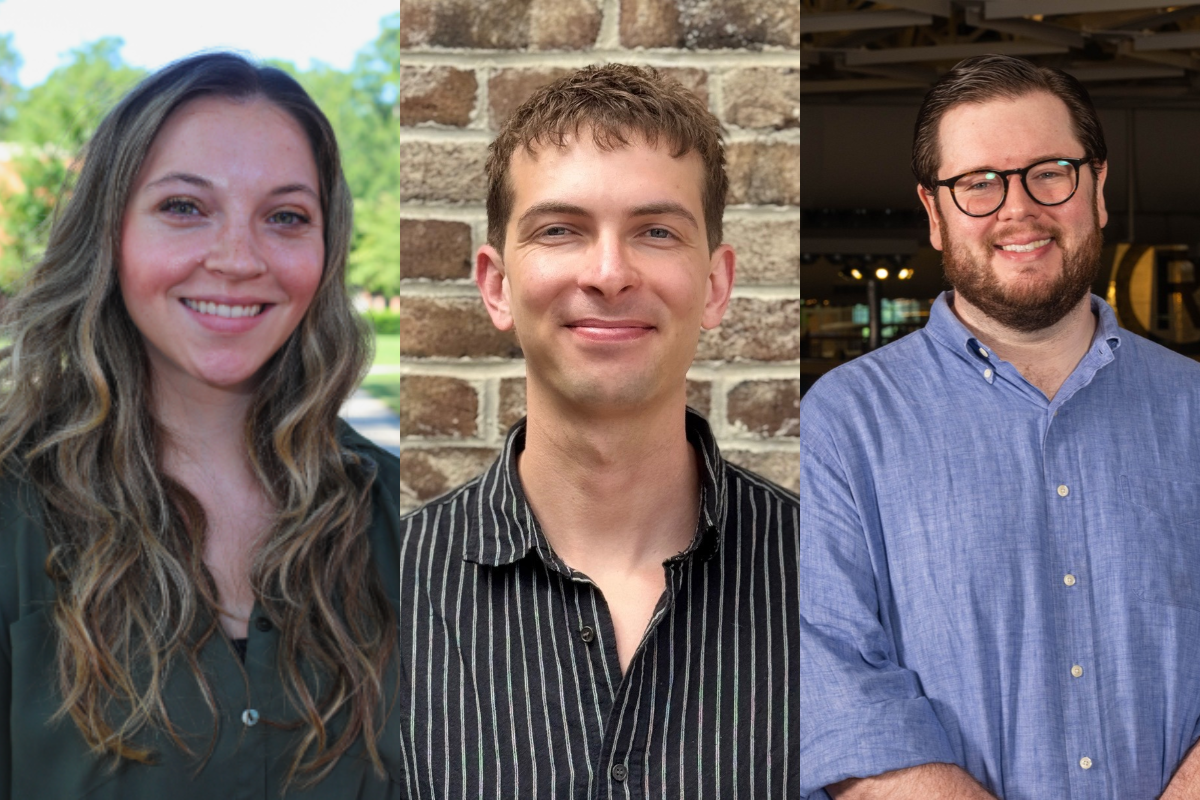
Three Peace psychology graduates have completed or nearly completed doctoral programs in the last few years: Tara Barricella ’18, Sam Arnold ’19, and Michael McHale ’20. Each followed different paths, but Peace’s curriculum challenged them to dive deeper into their interests and think critically about their futures.
“I’m just thrilled for all of them,” said Betty Witcher, professor and department chair of psychology. “It’s great to see students stay curious and carry on what you started together. I know they’ll be great in their careers.”
First-Generation Trailblazer: Merging Criminal Justice and Psychology
Originally from Pittsburgh, Pennsylvania, Barricella aimed to find a college where she would be more than just a number. Peace appealed to her as a first-generation student for this reason and for the downtown Raleigh campus’ charming, community-centered atmosphere. She initially planned a pre-law track, but Peace’s general education curriculum challenged her and sparked her interest in psychology.
“As a high school student, I took psychology, and I absolutely hated it, so I was dreading my general psych class as part of my gen ed requirements,” Barricella said. “But in that class, I found out about experimental psychology, which I was actually interested in. And then I figured out that I could interweave my interests in the criminal justice system and psychology together.”
That discovery led her to declare a double major in pre-law and psychology at Peace. She also pursued research opportunities with Witcher by setting up and conducting studies with participants.
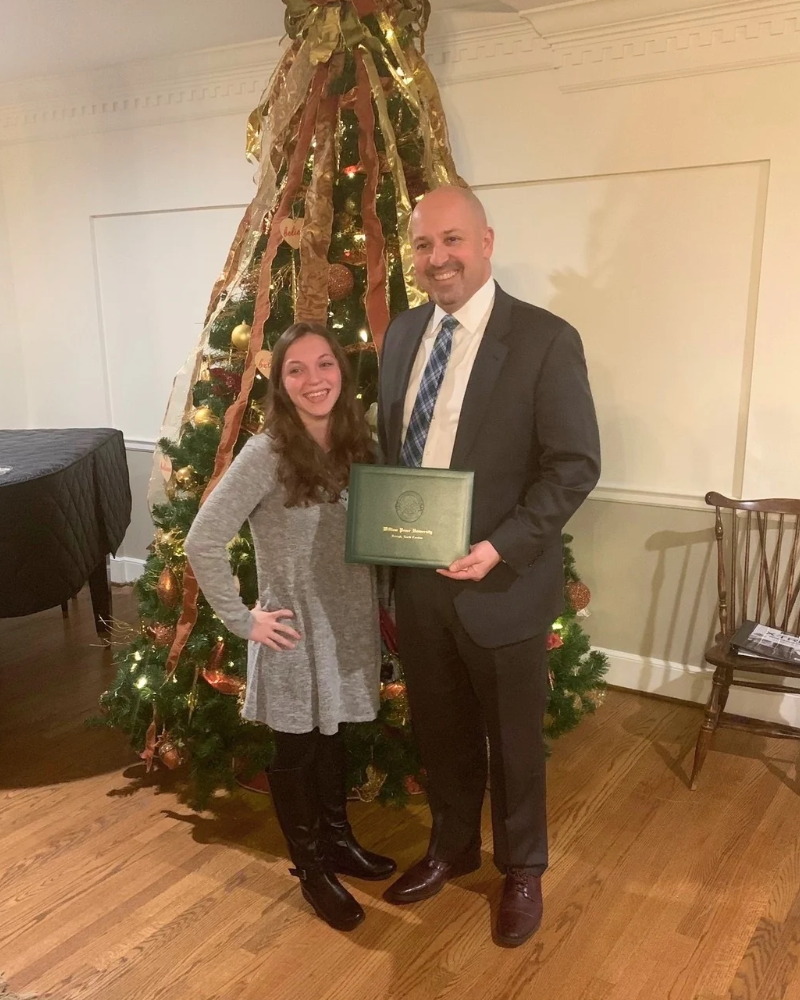
“Without that experience, I don’t think I would be a psychologist today,” Barricella said. “That immersive experience and one-on-one connection with my professors helped me be sure I was in the right spot and to ask questions I didn’t have answers to”
As Barricella neared the end of her time at Peace, Witcher advised her on her next academic steps and encouraged her to apply to the Master’s in Psychology with a General Experimental Psychology Concentration at the University of North Carolina at Greensboro. There, she began exploring her research interests in racial disparities in the criminal justice system. She then earned her Ph.D. in Social Psychology from Florida State University, where she began teaching for the first time. Now, Barricella is in her second year as an assistant professor of psychology at Randolph-Macon College.
“I have small classes like those at Peace, which is what I was looking for,” she said. “I know all my students by name, and I hope they feel as comfortable as I did coming to my professors, asking questions, and staying curious.”
Her mentorship from Witcher was so transformative that it’s shaped how she approaches education to this day.
“She showed me how to be a good mentor, advisor, and teacher,” Barricella said. “She was very interactive and led activities where we were involved in our learning, and those experiences have stayed with me for many years. I think back to her approach and adapt mine accordingly.”
From Homeschool to Faculty: Sparking Interest in Social Psychology
Arnold’s decision about which college to attend was intentional. Coming from a homeschool background, he sought a close-knit campus community to support his transition into traditional classrooms. Peace’s small size and prime location drew the Snow Camp, NC, native, who grew up on a horse farm and was curious about big-city opportunities.
“Peace was a great transition for me; I think I would have been swallowed up by a bigger school and not been as successful if I had been just one out of 200 students in a class,” he said.
Arnold had a hunch he wanted to pursue psychology but gave himself time to explore options before declaring a major. Within weeks of taking general psychology as a first-year, he knew this was the right path. “I instantly fell in love with that class; I was blown away and so intrigued by it,” he said.
The psychology department at Peace offers a wide range of disciplines and research opportunities, which helped Arnold solidify his interest in social psychology. He assisted with research on campus and pursued an independent study honors thesis with Witcher as his advisor. His topic focused on people’s willingness to identify with a political party after the 2016 presidential election. He later presented his findings at the National Conference for Undergraduate Research (NCUR) in 2018.
“That was an amazing experience that opened me up to what it might be like to do research, attend conferences, share ideas, and communicate findings beyond just science and data collection,” he said. “I didn’t know it would be an option to do research as an undergraduate, and that opportunity made me fall in love with research.”
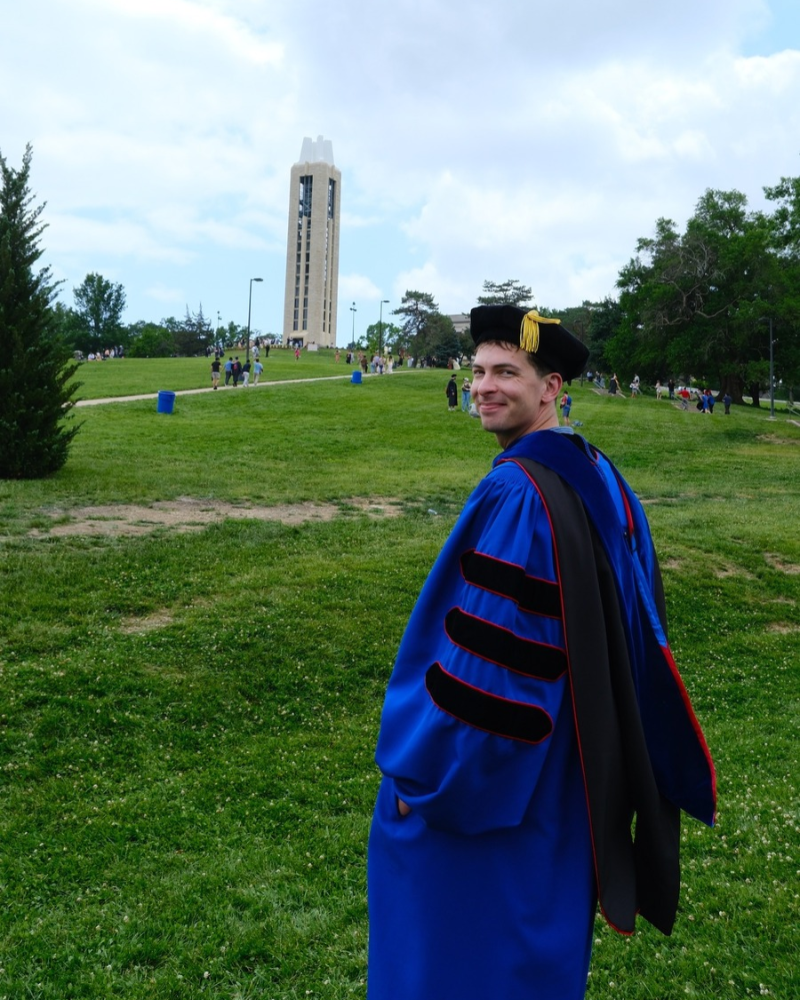
Arnold’s research at Peace helped him become a more competitive applicant for graduate programs. He earned a Master’s in Psychology at the University of North Carolina at Charlotte in 2021, where he continued his research and prepared to apply to doctoral programs. This past May, he earned his Ph.D. in Social Psychology from the University of Kansas.
“It felt like the culmination of all the work I’ve put in over the years,” he said. “I emailed several professors at Peace, like Dr. Witcher. I felt overwhelming gratitude to all who put in so much time to help me early in my academic career.”
Witcher shared some of the reactions she felt upon learning that Arnold had completed his Ph.D.
“Being a mentor is the best part of my job,” she said. “For Sam, one of the really nice things was getting to study what he was interested in and run with it, with just a little help from me. It’s very important to provide that flexibility.”
Now, Arnold is an assistant professor of psychology at the University of South Carolina Beaufort, where he teaches and mentors students while simultaneously continuing his research in social psychology.
“As I design my courses, I keep coming back to the courses I took at Peace because of how important they were in shaping what I wanted to do and how much they inspired me,” he said. “I model the concepts in class that had an associated activity because those are the concepts I still remember almost 10 years later. That’s what I try to do with my students. When they are active in the process, it’s not just a lecture; it’s like a conversation.”
A Family of Pacers: From Campus Leader to Ph.D. Instructor
In 2011, McHale watched his older sister begin her journey at William Peace University, then known as Peace College, an all-women’s school. During a visit in her first year, he casually told his parents he’d love to attend Peace if it became co-ed. After Peace adopted a co-educational model in 2012, McHale joined its student body in fall 2018, following in his sister’s footsteps and pursuing the Peace experience he had seen firsthand.
“It was one of those intangible things where I saw how great the culture was between everyone on campus, unlike anywhere else I’d seen,” he said. “At Peace, you get a lot of immersive learning; instead of passively sitting through lectures, you collaborate with professors.”
McHale quickly became involved in many areas of campus life, from admissions ambassador to orientation leader to peer tutor through the Center for Student Success. He built close mentorship relationships with several psychology faculty members, including Witcher, who advised his senior thesis and helped prepare him to present his research at NCUR.
“Having that one-on-one time and professors who provide mentorship really set me on a good path,” McHale said. “I think it is one of the most pivotal things in my career so far.”
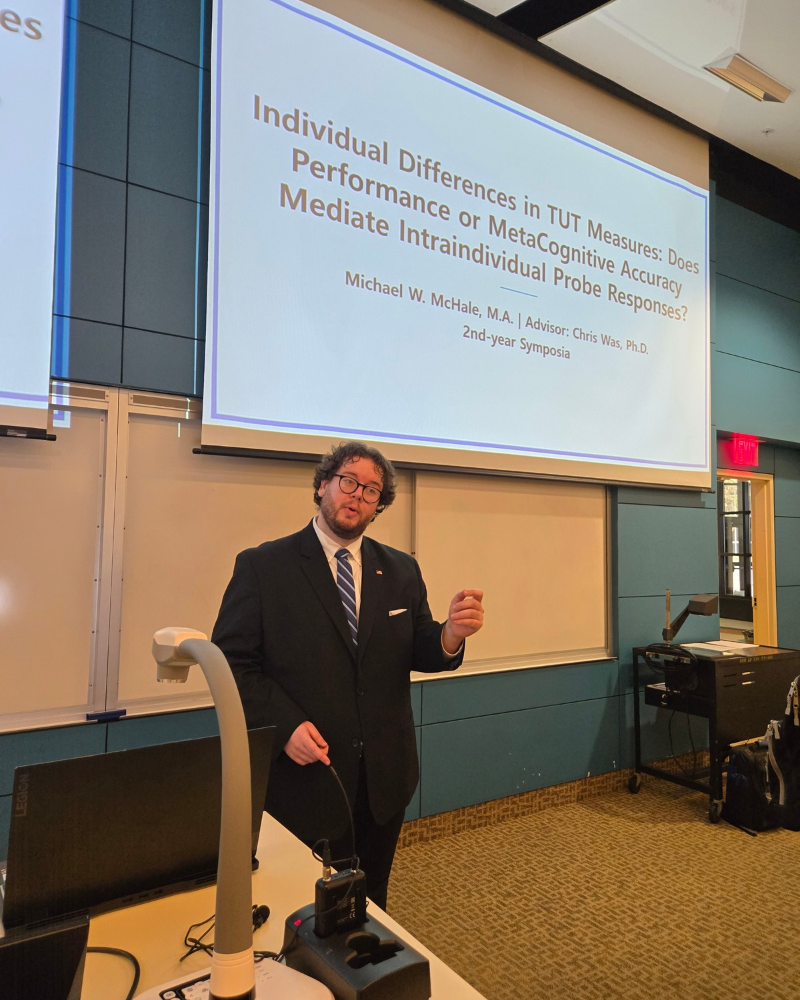
Witcher and fellow psychology faculty advised McHale as he explored graduate school options. After graduating from Peace in 2020, McHale earned a Master’s in Experimental Psychology from UNC Greensboro in 2023. He is now in the final year of his Ph.D. program at Kent State University, studying cognitive psychology with a concentration in quantitative methodology. As part of the program, he designs and teaches his own courses every semester and often looks back to his instruction at Peace for guidance.
“I try to infuse my experience at Peace into my teaching,” he said. “Whenever I get stuck as an instructor, I think about what Dr. Witcher or Dr. Blush would do, and I try to approach it that way. We are a large state school, but I want my students to have that same connection with me and feel supported.”
McHale also returned to Peace this semester as a psychology instructor for Peace Online. While he’s not sure if he will continue teaching after completing his Ph.D., he hopes to continue mentoring students and encouraging them to stay curious. His curiosity helped him discover a love of statistics within psychology that he didn’t know was an option before Peace.
“I was intimidated by statistics at first, but I developed an interest at Peace,” he said. “I then took more classes in graduate school and ended up concentrating in statistics. I did not foresee myself loving statistics as much or going on to teach it to undergrads, but I’m here because I stayed academically curious.”
Looking back, McHale holds a fond place in his heart for Peace. In 2025, he and his wife, whom he met at Peace, married on campus, symbolizing his enduring connection to the historic campus.
“My time at Peace had a real impact on me, and I think it directly changed the course of my life,” he said. “I met my wife there and realized I wanted to pursue psychology. Looking back, I see a common thread throughout my life, and much of it leads back to Peace.”


